
Before Manny Pacquiao ever laced a pair of gloves, one name stood tall in Philippine boxing, Gabriel “Flash” Elorde. Born on March 25, 1935, in Bogo, Cebu.
Elorde’s story is one of quiet beginnings, unshakable discipline, and international triumph. Long before boxing became a staple of Philippine pop culture, Flash was already carving his name into the annals of sports history.
Humble Beginnings in Bogo
Growing up in a modest family of 15 siblings, Elorde learned early the values of perseverance and resilience. He didn’t even finish elementary school—opting instead to help support his family by working various odd jobs. His boxing journey began informally, fighting in local bouts across Cebu, earning just a few pesos, but impressing crowds with his lightning-quick footwork—hence the nickname “Flash.”
Rising Through the Ranks
At just 16, Elorde turned professional and caught the attention of the national boxing scene. His graceful, southpaw style—later influenced by Filipino-American legend Ceferino Garcia—set him apart. But it was his training under Japanese fighter and trainer Koichi Wajima that refined his style into what would dominate the featherweight and junior lightweight divisions.
In 1956, Elorde shocked the boxing world by defeating Sandy Saddler, then the world featherweight champion, in a non-title bout in Manila. This victory put Elorde on the international radar.
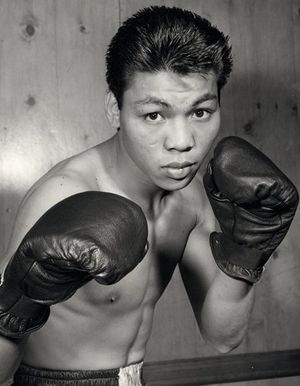
World Champion
On March 16, 1960, Flash made history. He defeated Harold Gomes of the United States via a seventh-round knockout in Quezon City, capturing the World Junior Lightweight Title—the first Filipino to win a world boxing title since Pancho Villa in the 1920s. Elorde held the title for over seven years, defending it 10 times, a feat that remains unmatched in junior lightweight history.
A Champion Inside and Outside the Ring
Elorde wasn’t just a fighter; he was a gentleman. Known for his humility, discipline, and sportsmanship, he embodied the ideal Filipino athlete. He became a national figure during the 1960s, endorsing brands and appearing in media, but never losing his roots in Bogo.
After retiring in 1971, he helped train a new generation of Filipino boxers and established a boxing promotion business that would carry his name—the Elorde Boxing Gym, now run by his sons and grandchildren.
Legacy and Honors
Flash Elorde passed away on January 2, 1985, at the age of 49 due to cancer. But his legend continues. He was posthumously inducted into the International Boxing Hall of Fame in 1993. In his honor, the Flash Elorde Awards recognize the best in Philippine boxing every year. A statue of him stands proudly at the Bogo City Plaza, reminding locals that greatness can rise from even the humblest of origins.
 InfoCebu