
The most recent census has just been released, revealing the official population count of each barangay across every town and city in Cebu. While Metro Cebu continues to bustle with urban expansion, traffic, and soaring high-rises, the latest numbers tell a story beyond the skyline.
Despite the province’s steady march toward modernization, Cebu remains home to several municipalities that seem untouched by time. These small, charming pueblos, hidden between mountain ranges or nestled along sleepy coastlines, carry with them a rustic spirit that resists the chaos of urban growth. Here, centuries have passed, yet the population has barely moved.
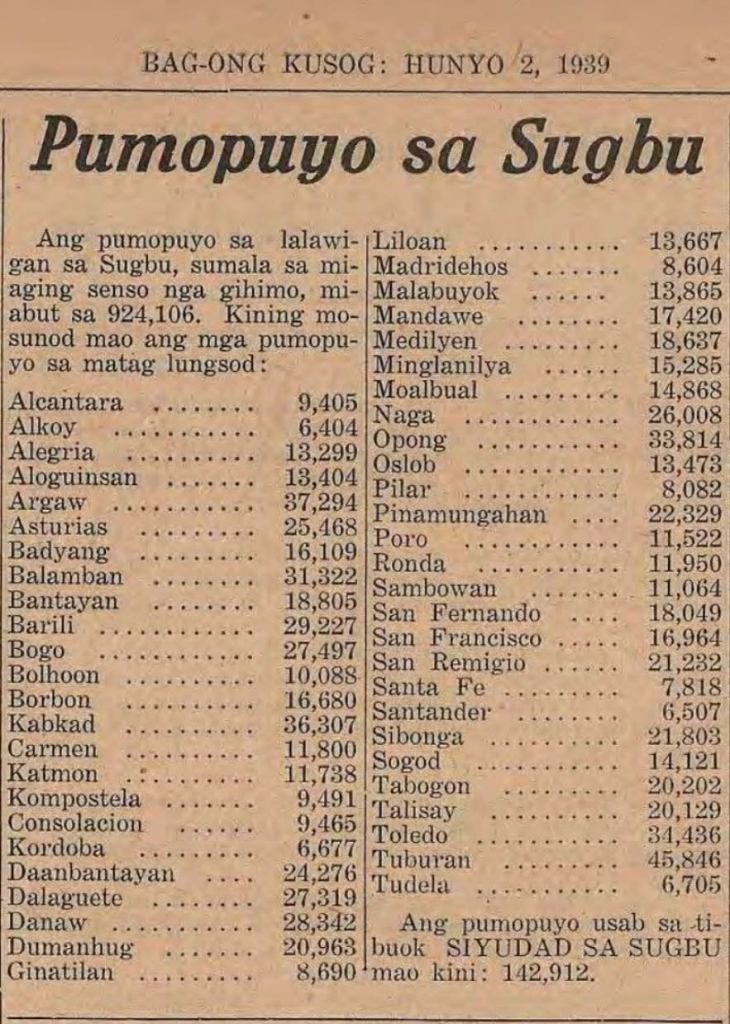
Now let us look back to a census conducted in Cebu in 1939. The entire province had a population of less than a million. Cebu was already a vital port and cultural hub, but it was still a far cry from the urban giant it is today.
At the time, Cebu City—then the only chartered city in the province—had a population of just 142,912.
But what may truly surprise you is the list of the most populous towns in Cebu back in 1939. Some of today’s lesser-known municipalities were once bustling centers of activity. Others that now enjoy rapid growth and cityhood status were, back then, quiet agricultural settlements.
MOST POPULATED TOWNS IN CEBU ( 1932 CENSUS)
Tuburan – 45,845
Argao – 37,294
Carcar – 36,307
Toledo – 34,436
Opon (now Lapu-Lapu City) – 33,814
Balamban – 31,322
These figures reveal an older Cebu where economic activity revolved around agriculture, fishing, and local trade, long before the rise of BPO hubs, airports, malls, and industrial estates.
Some of these towns, like Carcar and Danao, have retained their prominence, growing into cities in their own right. Others, such as Argao and Tuburan, while still thriving, have since been outpaced by the explosive growth of Metro Cebu and the Mactan corridor.
 InfoCebu