
From the January 16, 1931 issue of Bag-ong Kusog, we are offered a rare window into Cebu almost a century ago, its people, its culture, and the vibrant celebration of the Sinulog Festival. Long before modern parades, street dances, and grand concerts, Sinulog was already the beating heart of Cebuano faith and festivity.
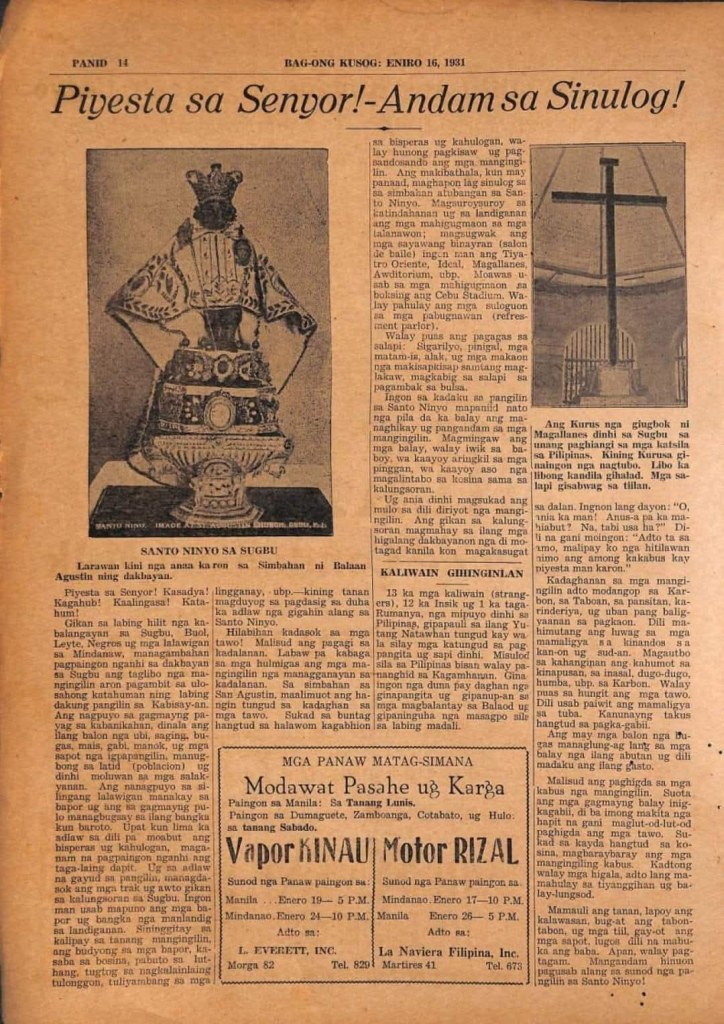
A Feast That Drew Thousands
Even in the early 1930s, Sinulog was no small-town affair. Pilgrims from every corner of Cebu, and even from neighboring islands such as Leyte, Negros, and Buol (likely Bohol), would travel to Cebu City days before the two-day fiesta. Ships arrived at the ports fully loaded with passengers, while trucks and vehicles from across the province poured into the city, bringing with them the anticipation of a grand celebration.
The newspaper described the scene vividly:
“Hilabihan kadasok sa mga tawo, malisud ang pag-agi sa kadalanan. Labaw pa kabaga sa mga hulmigas ang mga mangingilin…”
(Crowds were so dense it was difficult to move along the streets. The pilgrims were as numerous as swarms of ants.)
Faith and Devotion
As in today’s Sinulog, devotion to the Santo Niño lay at the heart of the festivities. Those who had made vows, mga may panaad, would spend the entire day at the Basilica, dancing their sinulog in front of the Holy Child. For many Cebuanos, this was an act of deep personal faith, a gesture of gratitude and petition that transformed the city into a living prayer.
A Festival Beyond Religion
Yet Sinulog in 1931 was not purely religious. Cebu’s fiesta spirit extended well beyond the churchyard. The city came alive with social events:
- Dance halls (Salon de baile) filled with music and merriment,
- Theaters such as Oriente, Ideal, and Magallanes Auditorium staging popular shows,
- Even boxing matches at the Cebu Stadium, which drew large and enthusiastic crowds.
The celebration spilled into every corner of the city. People converged in bustling districts like Taboan, Carbon, and Pansitan, where trade, food, and entertainment intertwined in a lively mix of faith and festivity.
A Century of Continuity
Nearly a hundred years later, the Sinulog Festival has grown into one of the Philippines’ grandest events, attracting millions of visitors from around the world. Yet, as this 1931 account reminds us, its essence remains unchanged: a city united in faith and festivity, welcoming pilgrims and revelers alike in honor of the Santo Niño.
Sinulog is indeed a cultural phenomenon, its soul rooted in the timeless devotion and joy of the Cebuanos, enduring from time immemorial to this very day.
 InfoCebu