Blog

The Last Dawn of the Cebu Tamaraw

From the displays of National Museum Cebu

Ten thousand years ago, in the damp cool of a Pleistocene morning, the slopes of Cebu stirred with movement. From the shadow of giant ferns emerged a small, sturdy figure, stocky legs planted firmly, crescent-shaped horns sweeping outward, dark eyes sharp with caution. This was the Cebu Tamaraw, Bubalus cebuensis, the island’s own wild water buffalo.

It was no towering beast like its mainland cousins. Standing barely 75 centimeters at the shoulder and weighing around 150 kilograms, it was a product of island dwarfism, nature’s quiet strategy for survival where food was scarce and space was tight. Here, smaller meant stronger in the long run, quicker to feed, easier to hide.

The tamaraw herds moved in loose groups, grazing the grass patches between Cebu’s forests. Mornings were spent feeding; afternoons, resting in the shade of almaciga and fig trees. They were not prey to be taken lightly. Their horns, though smaller than those of mainland buffalo, could gore a wild dog in a heartbeat. Their compact frames hid powerful muscles built for sudden bursts of speed.

The Shrinking World

But the island was changing. The Ice Age seas were rising, the lowlands shrinking. Grassland gave way to thicker forest. Food became harder to find. The herds grew restless, their trails narrower, their calves fewer.

And then came a new predator, humans. Armed with sharpened spears and clever traps, they began to stalk the tamaraws along the edges of the forest.

One legend tells of a herd cornered near the high ridges of what is now Balamban. Surrounded by hunters, the tamaraws lowered their heads and charged together, horns forward, hooves pounding, a living wall of defiance. They broke through the line once, twice, but the world they knew had already slipped away.

What Remains

Today, their bones tell the rest of the story. Fossil fragments found in Cebu’s caves revealed their small stature, robust teeth, and powerful legs, echoes of an animal perfectly adapted for its island home, yet ultimately unable to outpace change.

In the Cebu Museum, life-sized reconstructions stand frozen in eternal grazing, their black hides glistening under artificial sunlight. Visitors pass by, some pausing to imagine the real thing, moving in the mist, hooves wet with morning dew, vanishing into the green shadows of a Cebu that no longer exists.


Cebu Trans-Axial Highway: When Will It Finally Materialize?

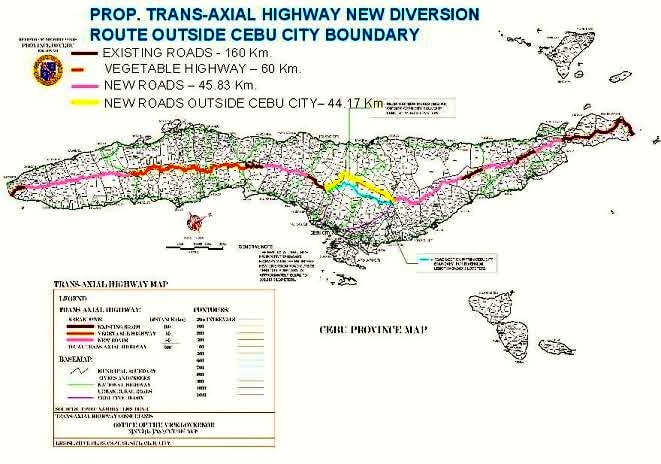
The dream of a 300-kilometer backbone expressway that will connect the southern tip of Cebu in Santander all the way to the northernmost town of Daanbantayan has been in the pipeline for years. Known as the Cebu Trans-Axial Highway, this ambitious infrastructure project is envisioned to serve as the island’s main arterial road, boosting connectivity, cutting travel time, and spurring economic growth across the province.

The project had its pre-feasibility study completed in 2008, marking the first step toward its realization. By 2013, it gained further traction when it was formally endorsed by the Regional Development Council (RDC), signaling strong local support and recognition of its potential to transform Cebu’s transportation landscape.

Yet, more than a decade later, the highway remains on the drawing board. The key reason: it is still awaiting approval from the National Economic and Development Authority (NEDA) national office. Without the green light from NEDA, the project cannot move forward to full feasibility studies, funding arrangements, and eventual construction.

During the 2025 campaign, Cebu Governor Pam Baricuatro mentioned that she would revive the plan, giving renewed hope to proponents who have long been calling for the project’s realization. With Cebu’s population and economic activity continuing to grow, they argue that the Trans-Axial Highway is no longer just a development vision but an urgent necessity.

For many Cebuanos, the question remains: When will this long-awaited expressway finally materialize? Until decisive action is taken, the dream of driving seamlessly from Santander to Daanbantayan will remain just that , a dream on paper.


🎙️𝗪𝗵𝗼 𝗗𝗼 𝗬𝗼𝘂 𝗟𝗶𝘀𝘁𝗲𝗻 𝗧𝗼?

Our opinions aren’t formed in a vacuum. They are shaped, little by little, by the voices we tune in to every day. In Cebu, for more than two decades now, two titans have ruled the early morning airwaves. Their voices have become fixtures in our daily routines, shaping public opinion one commentary at a time.

Even with the shutdown of ABS-CBN, veteran journalist Leo Lastimosa has continued to air his daily dose of political insight and sharp observation online, undeterred, unwavering, and unapologetically critical.

On the other side, a lawyer with a sharp tongue and a wit to match, Atty. Ruphil Banoc of DYHP / RMN delivers his views with a punch, often wrapped in humor, anecdotes, and direct hits.

Interestingly, they often have contrasting take on the prevailing issues of the day, two choirs singing from the far edges of the opinion spectrum.

From barbershops to roaming taxis, their voices ring out daily, steadfast in conviction, preaching their gospel-truth to any soul willing for communion.

Two styles. Two ideologies. Two loyal followings. Which voice influences you more? Who do you listen to? Atty. Ruphil Banoc or Leo Lastimosa

#CebuVoices #LeoLastimosa #RuphilBanoc #CebuRadio #PoliticalCommentary #InfoCebu

The Mentigi Point, Agujo, Daanbantayan

Duros Land Properties, a homegrown real estate developer, is taking a bold step into the northern frontier of Cebu with its newest flagship project: The Mentigi Point. A visionary master-planned development located in the idyllic coastline of Daanbantayan, the northernmost town in mainland Cebu.

Daanbantayan is known for its natural beauty, white sand beaches, upscale resorts, and world-class diving spots. Now, with The Mentigi Point, the town is set to become a landmark destination for both leisure and investment.

Project Highlights

Located in Lower Bantigue, Barangay Agujo, The Mentigi Point is a mixed-use development initially offering residential lots, perfect for private vacation homes or for long-term investments.

The next phase will offer resort-style condominiums, a hotel, a convention pavilion and a commercial strip by the beach.

Boasting of more than 300 meters of white sand beach frontage, endless fun awaits the whole family at The Mentigi Point.

Duros Land Properties Inc, has a proven legacy of transforming potential into prosperity. From building an 18-hole golf course in Barangay San Roque, and a 14 storey hotel in Barangay Yati, both in Liloan, Duros Land brings a level of commitment and experience that elevates every location it touches.

As a leisure-oriented developer, it commits to deliver two things to its buyers: Expansive open spaces and exceptional amenities.

With The Mentigi Point, Daanbantayan stands ready to announce to the world that it is no longer a hidden gem, but a rising star in Cebu’s future. 5 minutes away is the Daanbantayan Astrodome (under construction) while Bogo City’s commercial district and the soon-to-rise Medellin Airport are both less than 30 minutes away.

Only one missing element to complete The Mentigi Point.……You.

DHSUD TLTS: 061 series 2025

Too Deep, Too Costly: The Reality of a Cebu–Bohol Bridge

Many have dreamed of a bridge linking Cebu and Bohol, a bold connection that could transform travel and trade between the islands. But while the idea is captivating, the reality beneath the waters of the Mactan–Olango channel tells a different story, one of extraordinary depth, complex engineering, and massive costs. This isn’t to say it will never happen, but for now, the bridge remains a vision tempered by practical challenges.

It is extremely challenging from technical, financial, and environmental standpoints.


1. Distance and Scale

  • The shortest straight-line distance between Central Cebu (Cordova area) and northern Bohol (Jetafe) is about 20–25 km.
  • For comparison, the Cebu–Cordova Link Expressway (CCLEX) is only 8.9 km long.
  • A Cebu–Bohol bridge would therefore need to be 2–3 times longer than CCLEX, making it one of the longest sea-crossing bridges in Southeast Asia.

2. Deep and Complex Sea Bed

  • The Cebu Strait and Bohol Strait have deep waters (up to 200 m in some areas) with strong tidal currents especially the area between Olango and Mactan.
  • Deepwater bridge piers would be technically difficult and extremely costly to construct.
  • Similar projects worldwide (e.g., Hong Kong–Zhuhai–Macau Bridge) required advanced engineering and huge budgets due to deep seabeds and typhoon-prone conditions.

3. Environmental Concerns

  • The area between Cebu and Bohol is part of the Danajon Double Barrier Reef, one of the few double barrier reefs in the world.
  • Construction could damage coral reefs, seagrass beds, and fisheries, affecting local communities dependent on fishing.
  • Environmental compliance and opposition from conservation groups would significantly delay or block such a project. The new Cebu Archbishop Alberto Uy already announced last year when he was still assigned in Tagbilaran that he will oppose the plan to build a bridge.

4. Weather and Seismic Risks

  • The Visayas region is typhoon-prone. Designing a bridge that can withstand typhoon winds, storm surges, and saltwater corrosion would drastically increase costs.
  • The area is also near the Philippine Fault Zone, raising earthquake risk concerns.

5. Shipping Lanes

  • The Hilutungan Channel is a busy navigation route for cargo and passenger vessels.
  • The bridge would need very high clearance or an alternative design (such as a suspension span) to avoid obstructing maritime traffic.

5. Cost Impact

  • The Mactan–Olango crossing would require:
    • Extremely tall pylons (comparable to or taller than the Akashi Kaikyō Bridge in Japan), or
    • A subsea tunnel segment, which is even more costly.
  • This section alone could drive up the project cost by tens of billions of pesos.

5. Economic Viability

  • Estimated cost for a 20–25 km sea bridge could exceed ₱200–300 billion (USD 3.5–5 billion).
  • Given the population and traffic demand between Cebu and Bohol, toll revenue may not justify the investment.
  • Ferry services currently provide a cheaper alternative for both passengers and cargo.

6. Alternative Solutions Already in Place

  • Fast crafts and Ro-Ro ferries already connect Cebu and Bohol efficiently in about 1.5–2 hours.
  • Expansion of port facilities or faster ferries would be far cheaper than a fixed bridge.
  • The government should provide incentives to private companies investing in modern catamarans, like those built in Balamban and delivered to Denmark and other

Conclusion:
While technically it may be possible, a Cebu–Bohol bridge faces extreme engineering, environmental, and financial barriers. For now, improving ferry infrastructure remains a far more realistic and cost-effective solution.

It is commendable however, that our government officials are having this conversation, so as to open any infrastructure plan to public scrutiny and healthy exchange of ideas.

Incidentally, there are urgent and crucial infrastructure projects that Metro Cebu need as recommended in a comprehensive study conducted by JICA . contained in a final report they submitted in 2019.

(Will write a story within the day)