
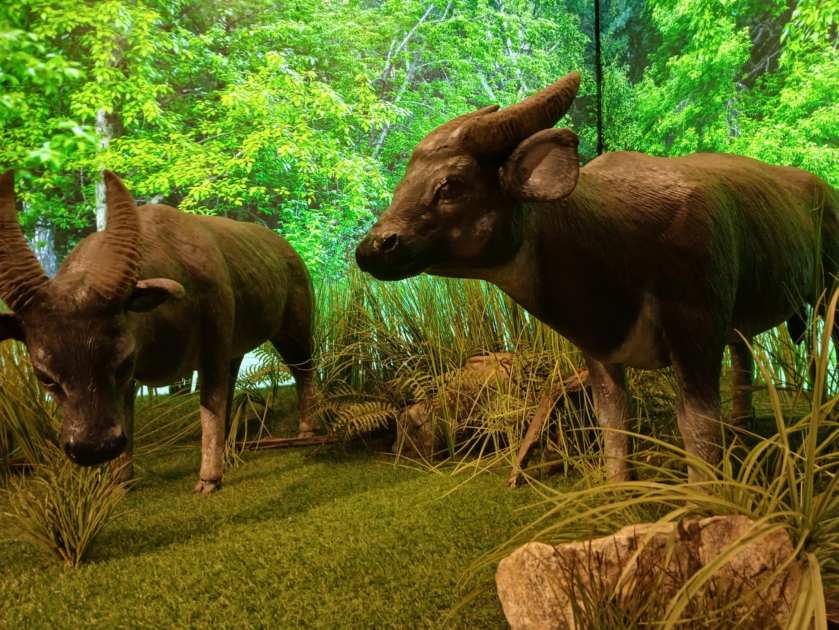
Ten thousand years ago, in the damp cool of a Pleistocene morning, the slopes of Cebu stirred with movement. From the shadow of giant ferns emerged a small, sturdy figure, stocky legs planted firmly, crescent-shaped horns sweeping outward, dark eyes sharp with caution. This was the Cebu Tamaraw, Bubalus cebuensis, the island’s own wild water buffalo.
It was no towering beast like its mainland cousins. Standing barely 75 centimeters at the shoulder and weighing around 150 kilograms, it was a product of island dwarfism, nature’s quiet strategy for survival where food was scarce and space was tight. Here, smaller meant stronger in the long run, quicker to feed, easier to hide.
The tamaraw herds moved in loose groups, grazing the grass patches between Cebu’s forests. Mornings were spent feeding; afternoons, resting in the shade of almaciga and fig trees. They were not prey to be taken lightly. Their horns, though smaller than those of mainland buffalo, could gore a wild dog in a heartbeat. Their compact frames hid powerful muscles built for sudden bursts of speed.
The Shrinking World
But the island was changing. The Ice Age seas were rising, the lowlands shrinking. Grassland gave way to thicker forest. Food became harder to find. The herds grew restless, their trails narrower, their calves fewer.
And then came a new predator, humans. Armed with sharpened spears and clever traps, they began to stalk the tamaraws along the edges of the forest.
One legend tells of a herd cornered near the high ridges of what is now Balamban. Surrounded by hunters, the tamaraws lowered their heads and charged together, horns forward, hooves pounding, a living wall of defiance. They broke through the line once, twice, but the world they knew had already slipped away.
What Remains
Today, their bones tell the rest of the story. Fossil fragments found in Cebu’s caves revealed their small stature, robust teeth, and powerful legs, echoes of an animal perfectly adapted for its island home, yet ultimately unable to outpace change.
In the Cebu Museum, life-sized reconstructions stand frozen in eternal grazing, their black hides glistening under artificial sunlight. Visitors pass by, some pausing to imagine the real thing, moving in the mist, hooves wet with morning dew, vanishing into the green shadows of a Cebu that no longer exists.
 InfoCebu