
For more than 500 years, the humble horse-drawn carriage, Tartanilla or Parada to Cebuanos, has been quietly and faithfully moving people through the streets of Cebu. While empires have risen and fallen, and cars have gone from steam to diesel to electric, the tartanilla continues its journey, one slow, steady trot at a time.
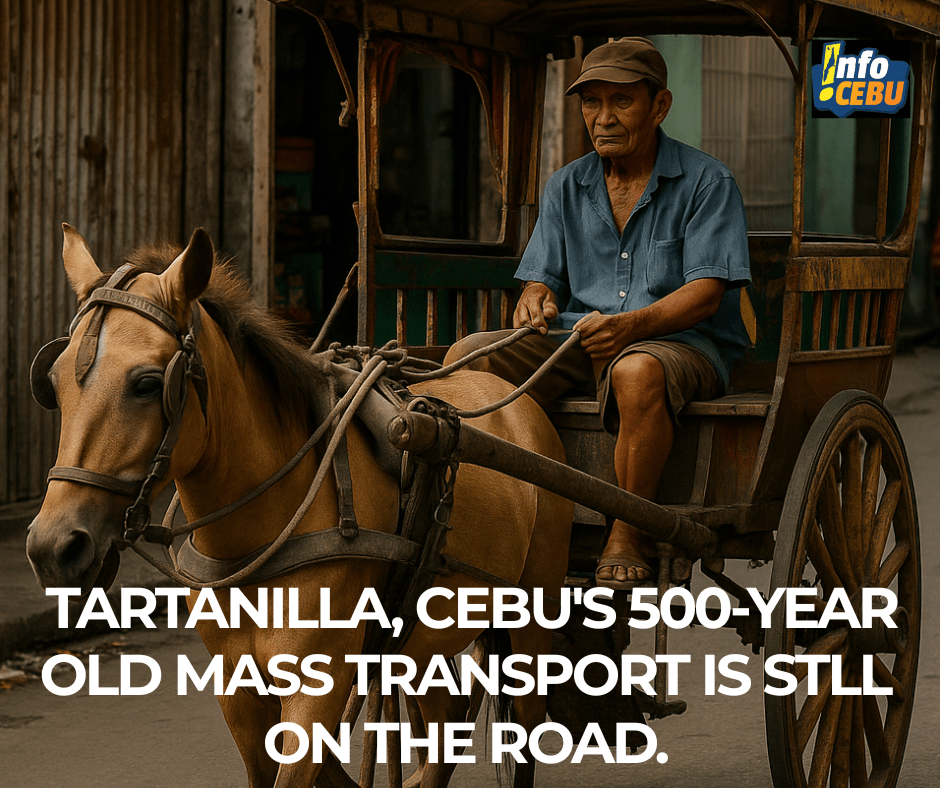
In a world racing toward artificial intelligence and space tourism, it’s almost absurd, and absolutely beautiful, that a mode of transportation pulled by a living, breathing animal still shares the road with Teslas and e-bikes.
And yes, they’re still here.
Not just for tourists, not for display in a museum, but for actual, daily, public transportation. While you may also find them in Intramuros and Vigan with their Barong-wearing Kutseros, but those are just for picture taking and short tours for tourists. A cultural preservation you can call it, but in Cebu, they still toil in the same manner as 500 years ago, oblivious to the changes in the world around them.
🐴 A Horse, a Carriage, and a Century of Service
Long before Uber, Grab, or even the Ceres bus, Cebuano commuters had the tartanilla. Derived from the Spanish calesa, the tartanilla was the preferred ride of both the masa and the ilustrado, serving everyone from market vendors to priests, from public school kids to Katipuneros on secret missions.
Their routes once stretched from Pari-an to Pasil, from the Cathedral to Colon, and even up to Lahug and Guadalupe. They were the icons of a pre-war Cebu, when crossing town meant taking a tartanilla, not hailing a ride-share app.
Back then, horses didn’t just pull people, they pulled a city forward.
🐎 Not Just a Memory
Fast forward to today, and while many Cebuanos believe the tartanilla is extinct, like the telegraph or love letters, a small herd of these faithful four-legged taxis still clip-clop their way through Duljo–Fatima, B. Aranas, Pasil, Taboan and Carbon Market.
In 2023, the Cebu City Department of Veterinary Medicine and Fisheries recorded 34 operational tartanillas in the downtown area. The number may have shrunk since, but their impact, and charm, has not.
“Actually, it is still effective,” says Dr. Jessica Maribojoc, DVMF head. “There are still passengers who prefer riding them.”
She adds that there is even a city proposal to formally integrate tartanillas into a heritage transport system, especially around Cebu City Hall to Colon Street, areas rich in culture and stories.
🩺 Horses with Check-Ups
These aren’t neglected animals left to suffer in the heat. Twice a year, city vets visit each kutsero and horse, providing:
Vitamins
Physical checkups
Blood tests for infections
Proper hoof and skin care
It’s a community effort to keep both the horses and history alive.
⚙️ Obsolete Things… Except the Tartanilla
Let’s pause and reflect:
We’ve landed on the moon.
We’ve abandoned the steam engine, the telegraph, and dial-up internet.
No one sends mail by horse courier anymore.
Cassette tapes? Gone.
Typewriters? Museum items.
And yet… the tartanilla lives.
Somehow, the horse — this ancient, loyal creature, is still on the road, racing (albeit politely) with cars that now run on gasoline, diesel, or electricity.
“Init ug ulan, abog, ka kapoy gi agwanta ang tanan……”
—
🤣 And Now, A Little Horse Sense
Think about it:
No traffic gridlock. Horses don’t rush; they keep it moving, slow and steady.
No carbon emissions. Zero-emission, 100% compostable.
No engine failures. Just hay and water.
No parking problems. They’ll stop where you say “preno.”
And drunk driving? Totally fine. Because let’s face it: the horse knows where it’s going. You don’t steer a tartanilla, the horse does. So technically, the driver is just the passenger with a whip.
In a world where smart cars can drive themselves, Cebu already had the solution: a horse with a brain and a direction.
❤️ Clip-Clopping Into the Future
So the next time you’re stuck in traffic on SRP, watching the fuel gauge drop and your temper rise, remember: there are still horses in Cebu that get to their destination faster than you.
The tartanilla isn’t just transportation. It’s Cebu’s heartbeat on wheels, a living relic, and a reminder that sometimes, the old ways still work, even better than the new.
And perhaps the best part? When the day ends, and the kutsero lets the reins go slack, the horse already knows the way home.
 InfoCebu