Golden Gate Memorial Gardens: A Timeless Investment in Daanbantayan, Cebu

In the Philippines, we often talk about investing in condominiums, house-and-lots, or commercial properties. But there is one type of real estate investment that many overlook yet it carries both financial wisdom and emotional value: pre-selling memorial gardens.

Unlike other assets, memorial lots are not just pieces of land. They are sacred spaces where families find comfort, remembrance, and peace. And while it may be uncomfortable to talk about, preparing ahead is one of the most meaningful legacies you can leave behind.
Golden Gate Memorial Gardens: A First for Daanbantayan

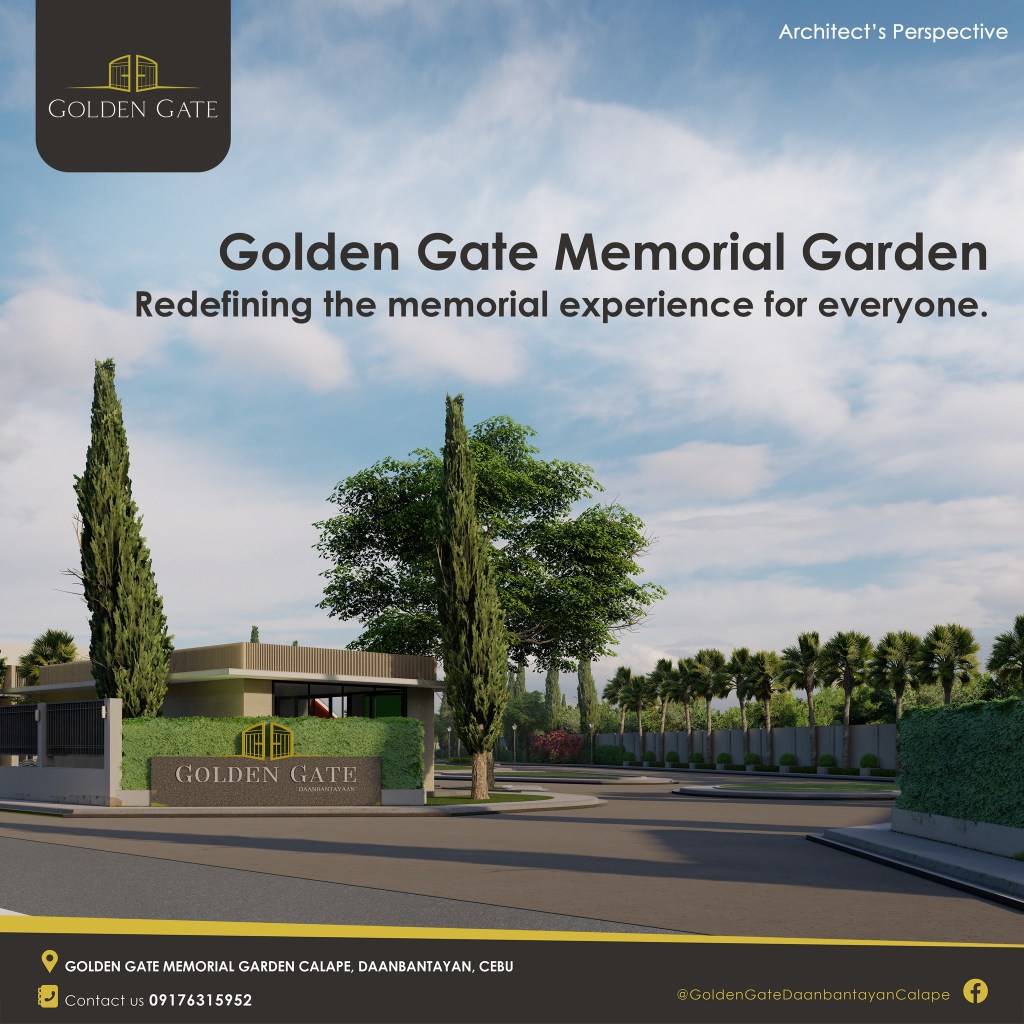
One remarkable example is Golden Gate Memorial Gardens, a new pre-selling project in Calape, Daanbantayan, Cebu. It is the first high-end memorial garden in town, designed not only as a place of rest but also as a landmark of serenity and heritage.

Golden Gate will feature:

Lawn lots and Family estates for dignified spaces of remembrance

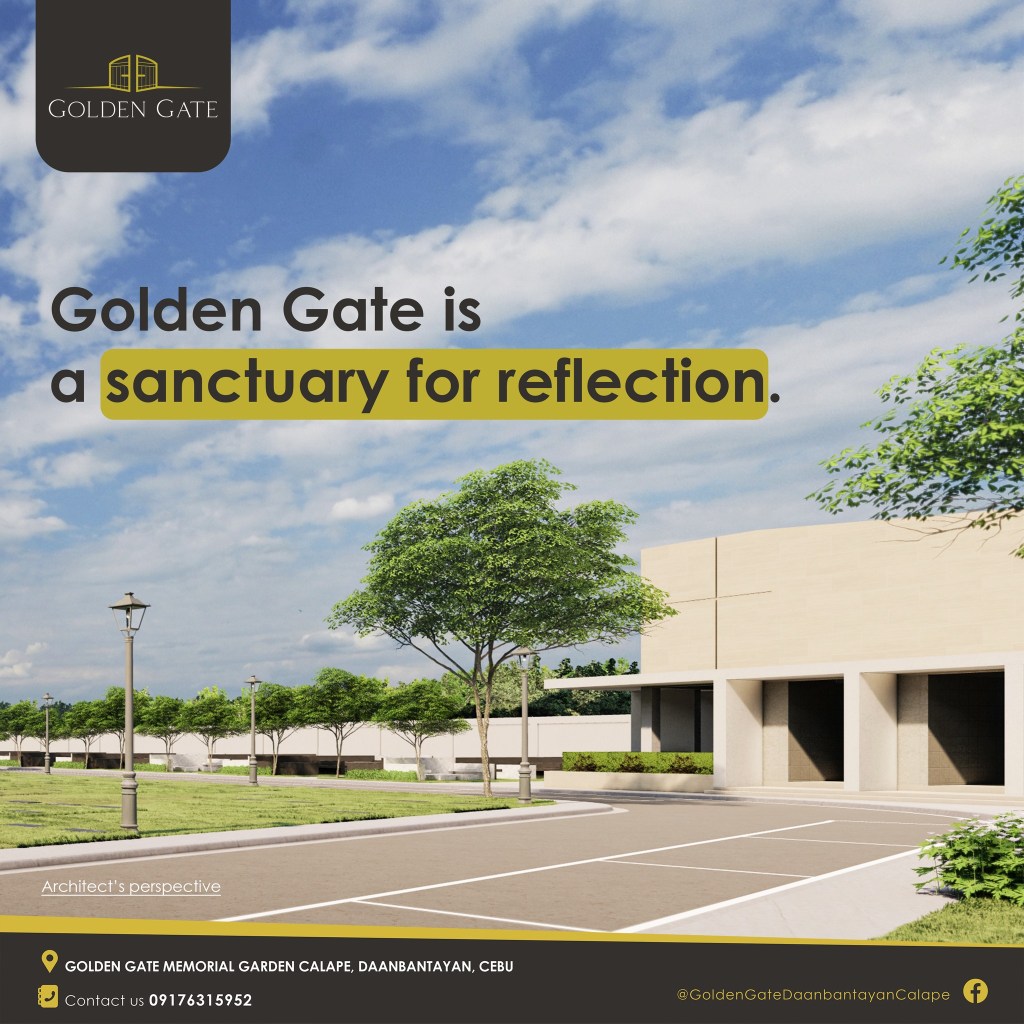
A modern chapel for solemn gatherings and reflection

A columbarium for families choosing cremation

Kids playground

A cozy coffee shop, yes you’ve read it right!

And its iconic centerpiece, The Sentinel, a stunning 23-meter obelisk that will stand as a symbol of legacy, love, and eternal memory.

The Sentinel

Importantly, Golden Gate already has its License to Sell from the government, which means buyers can invest with full confidence in the project’s legitimacy and security.

Timing Matters: Groundbreaking and Introductory Pricing

The groundbreaking ceremony is set for September 5, marking the beginning of this landmark development. Until that date, Golden Gate is offering its lots at an introductory price, making it the best time to invest.

After the groundbreaking, prices will increase, reflecting the project’s added value as construction begins. Early investors will not only secure the most affordable rates but also maximize the appreciation of their investment in the coming years.

A Growing and Everlasting Demand

Unlike condominiums or subdivisions where market demand may fluctuate, memorial gardens carry a demand that never diminishes. Every Filipino family will eventually need a resting place for their loved ones. This reality makes memorial lots one of the most stable and recession-proof investments.

Protecting Loved Ones from Future Burdens

The most emotional aspect of this investment is its impact on your family. In times of grief, the last thing we want our loved ones to worry about are rising costs and last-minute arrangements. Having a memorial garden secured in advance spares your family from additional emotional and financial stress.

A Legacy Beyond Wealth

When you buy a memorial lot today, you are not only making a sound financial move—you are also giving your family the gift of foresight. You are telling them: “I have thought of you. I want to make things easier when the time comes.”

Real estate will always be a wise investment, but investing in Golden Gate Memorial Gardens in Daanbantayan, Cebu carries a deeper meaning. With its world-class design, and limited time introductory pricing before its September 5 groundbreaking, Golden Gate is an investment in land and an investment in peace of mind, family legacy, and eternal remembrance.
Memorial LTS No. 058

Columbarium LTS No. 0002202
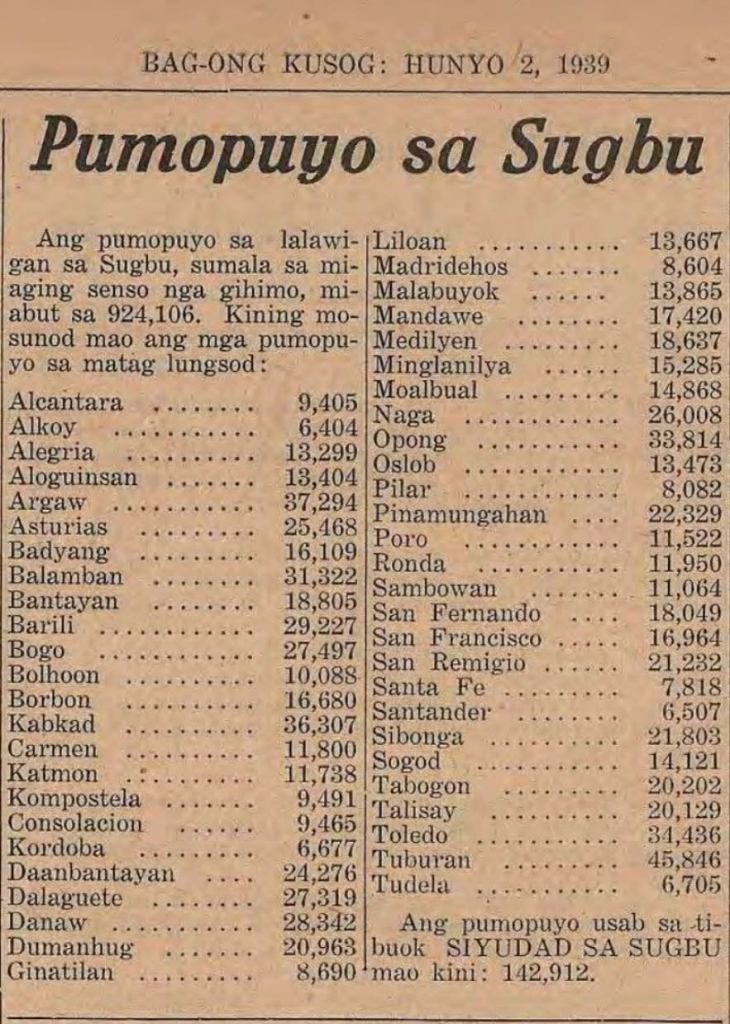
CEBU POPULATION IN 1939

The most recent census has just been released, revealing the official population count of each barangay across every town and city in Cebu. While Metro Cebu continues to bustle with urban expansion, traffic, and soaring high-rises, the latest numbers tell a story beyond the skyline.

Despite the province’s steady march toward modernization, Cebu remains home to several municipalities that seem untouched by time. These small, charming pueblos, hidden between mountain ranges or nestled along sleepy coastlines, carry with them a rustic spirit that resists the chaos of urban growth. Here, centuries have passed, yet the population has barely moved.

Now let us look back to a census conducted in Cebu in 1939. The entire province had a population of less than a million. Cebu was already a vital port and cultural hub, but it was still a far cry from the urban giant it is today.

At the time, Cebu City—then the only chartered city in the province—had a population of just 142,912.

But what may truly surprise you is the list of the most populous towns in Cebu back in 1939. Some of today’s lesser-known municipalities were once bustling centers of activity. Others that now enjoy rapid growth and cityhood status were, back then, quiet agricultural settlements.

   MOST POPULATED TOWNS IN CEBU ( 1932 CENSUS)

Tuburan –                       45,845

Argao –                           37,294

Carcar –                          36,307

Toledo –                          34,436

Opon (now Lapu-Lapu City) – 33,814

Balamban –                     31,322

These figures reveal an older Cebu where economic activity revolved around agriculture, fishing, and local trade, long before the rise of BPO hubs, airports, malls, and industrial estates.

Some of these towns, like Carcar and Danao, have retained their prominence, growing into cities in their own right. Others, such as Argao and Tuburan, while still thriving, have since been outpaced by the explosive growth of Metro Cebu and the Mactan corridor.

Where to Invest in Cebu Real Estate?

Cebu has long been a top destination for real estate investment in the Philippines. With a robust economy, a growing population, improved infrastructure, and rising demand for specialized properties, it continues to attract both local and international investors. But where exactly should you invest today? Here are the three most promising sectors in Cebu real estate:

1. Invest in Leisure-Oriented Developments

Leisure-oriented real estate is currently the number one product in the Philippine property market, and Cebu is no exception. These developments include condo-hotels, beach resorts, mountain view subdivisions, retirement villages, wellness estates, and eco-tourism enclaves.

What makes them so attractive? The shift in lifestyle preferences after the pandemic has fueled demand for spaces that blend relaxation, wellness, and work-from-anywhere setups. Cebu’s world-class beaches, cool highlands, and strong tourism brand make it the perfect location for this kind of development.

🟢 Why invest here? Cebu is becoming a prime destination for domestic and foreign tourists, retirees, and digital nomads. Leisure properties promise strong returns via rental income, capital appreciation, and even joint ventures with hospitality operators.

📌 Read more: Why Leisure-Oriented Developments Are the New Gold in Philippine Real Estate (https://www.google.com/…/dissecting-the…/%3famp)

Cebu is still top tourist destination in the country.

https://cebudailynews.inquirer.net/…/cebu-welcomed-over…

2. Invest in Commercial Real Estate in Growth Towns

The next big opportunity lies in commercial properties for lease, especially in emerging towns outside Metro Cebu. We’re talking about areas like Bogo City, Oslob, Balamban, Moalboal, and Daanbantayan, towns with growing populations and rising consumer demand.

Think commercial strips, lots for banks, drive-thru fast food outlets, warehousing, and rental spaces for small enterprises. With the continued widening of highways and the proposed new infrastructure projects, these towns are now closer than ever to the city center, but come at a fraction of the cost.

🟢 Why invest here? Commercial real estate in provincial growth centers generates steady monthly income and benefits from Cebu’s decentralization — where people live, work, and spend outside the metro.

3. Invest in Columbariums and Memorial Real Estate

Yes, columbariums are a legitimate and increasingly necessary form of real estate investment, especially in Cebu City, where there’s a growing cemetery space crisis. With the high cost and scarcity of traditional burial plots, more families are turning to cremation, and this trend is pushing demand for urban memorial parks, columbarium vaults, and chapel complexes.

Take for example True Vine Garden Columbary in Cebu City, which offers a peaceful and dignified space for remembering loved ones, while also providing a high-value investment opportunity for developers and landowners.

🟢 Why invest here? It’s a niche but growing market. Unlike most forms of real estate, columbarium spaces are non-cyclical, there’s always demand, and they require minimal upkeep while offering recurring income through vault sales and maintenance fees.

Cebu’s real estate landscape is evolving. It’s no longer just about condos in the city or residential subdivisions. Investors who are willing to look at leisure properties, commercial hubs in rising towns, and memorial real estate stand to benefit from new demand trends.

Whether you’re a developer, a broker, or a small investor, the key is to invest where the growth is going, not where it has already peaked.

#realestate#Cebu#cebucity#infoCebu#properties#realestatebroker#realestateagent#ForSaleProperties#houseforsale#lotforsale#condominium#condoforsale#condoforrent

Metro Cebu is running low on space for new houses

Only 8% of Cebu is flat land and it is depleting very fast. Scarcity drive prices up and with no other option, Cebu’s expansion will be skyward.

Cebu IT Park, then and now

Cebu has a limited buildable space. Only eight percent (8%) of its total land area is flat and this is stretched along the coastline of an elongated island. There are only two growth directions. Go north or move south.

Early days

In the 60’s, southward development began in San Nicolas Mambaling area. Subdivisions like Ma. Gochan with its fruity streets Avocado, Bayabas, Caimito, etc were established for new families.

Today, this area is very near to the city center but in those times, it was considered far. It was the distance of the ‘Parada‘ (Calesa).

Then Labangon, Punta Princesa and Tisa were developed next. Residential structures took over the corn and peanut fields, as demand for new housing steadily increase

The city government of Cebu realized the scarce land resource and the need to address the requirement of a rapidly growing city.

North Reclamation in the 90’s

Plans were initiated for the north reclamation project which eventually became the home of SM City Cebu, the first mall outside Metro Manila.

The 70’s saw expansion crawling towards the barangays of Pardo in the South and Mabolo in the north. Even with the Martial Law, economy in Cebu remained vibrant.

The 1st Mactan bridge

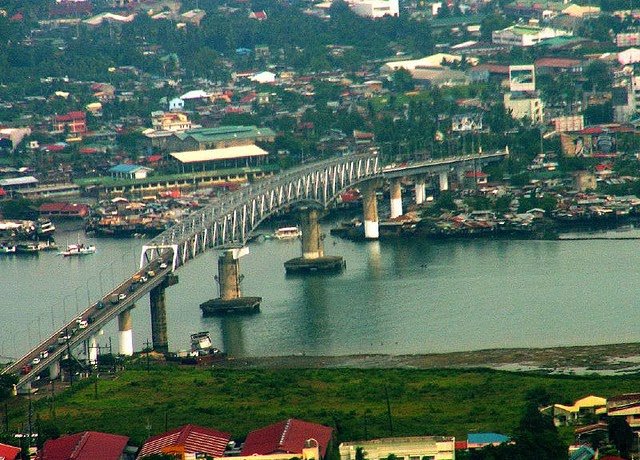
Marcos built the first Mactan bridge which opened up the island for economic and tourism activities.

The 80’s saw major expansion in Cebu, filling the hills of Guadalupe all the way to Pardo.

In the north, Lito Osmena (EMRO Holdings) moved farther north the haven of the ultra-rich, Maria Luisa Subdivision.

Banilad at that time was considered a distant suburb. I remember buying Japanese corn in a sparsely populated stretch in today’s BanTal road, which became Gaisano Country Mall not long after.

Gaisano Country Mall

The 90’s saw an unprecedented growth in Cebu. Dubbed “Ceboom”, the tandem of governor Lito Osmena and Mayor Tom Osmena opened Cebu to opportunities never seen before.

Cebu Business Park, then and now

Manila developers went on crazy shopping for land. Ayala cornered the provincial lot used as a golf course and the Lahug airport property, both of which are now bustling business districts. SM also secured the greatest chunk in the new reclamation.

Residential expansion now extends to Talisay city and Mandaue city. The northward expansion also shifted eastward to Mactan island because of the transfer of the new airport and the creation of Mactan Export Processing zone.

Low cost housing became a hit, selling in the thousands as Pag-Ibig loan facility became available.

The SRP when it was newly completed

Mayor Tom Osmena then floated the idea of a south reclamation project even before the one in the north was completely sold-out.

The early nineties was also called the age of malling as three giant malls opened in Cebu City within an 18-month period. Gaisano Country Mall, opened in 1992 followed by SM City Cebu then Ayala Center Cebu (ACC) in 1993.

How these malls almost killed the businesses in Colon street will be a good separate story.

Vertical Homes

Condominiums started out in Cebu as mere status symbol for the rich. But it was short-lived with the onset of the Asian Crisis in 1997-98.

The slowdown in real estate activities continued into the new millennium although low and mid-high properties continue to sell.

Then there was the second wave of Ceboom in 2006. It just exploded out of nowhere and real estate growth went exponential since then.

Two things happened, residential properties are now pushed farther north to Compostela and down south to Naga city, but traffic also started to deteriorate and became a daily occurence.

Traffic woes and scarcity of space made condominiums a necessity in Cebu rather than an item of luxury as it was before.

Reaching the limit

Areas after Compostela in the north and Naga City in the south are no longer viable as residence for low and mid-income families who commutes daily for school and work in Cebu City. It is a total waste of time, productivity and money.

Metro Cebu

Nowhere to go

This is a clear indicator that Cebu has nowhere to go but up. The future is in the skies.

There are ambitious plans to build highways slicing through the mountain or a viaduct above the sea. Even a mass transport system, probably the rail type is in the works.

But these infrastructures take time to build, and while they help in moving people fast, the scarcity of land remains. It is irreversible.

Developers know its a dire situation. They now scamper hard even for small parcels of land just to be able to churn out projects like pocket developments.

Colliers International shared this sentiment in a report: Condo demand high as developers faced with land scarcity.

Now is the only time

Cebu’s topography is telling us its not just the best time to buy a house now but its the only time left before prices will become exceedingly expensive. Scarcity drive prices up.

If you have money to invest, do not wait and see, for waiting is a costly exercise in real estate. Buy now then sit back and watch the value of your property grow.

When all the land is utilized, Cebu’s future development will be skyward. A true skyscraper city in the making.

*********

Credit goes to the owners of images used. Special mention Slerz, whose passion for Cebu is unwavering, a fellow Skyscrspercity forumer and a good friend.

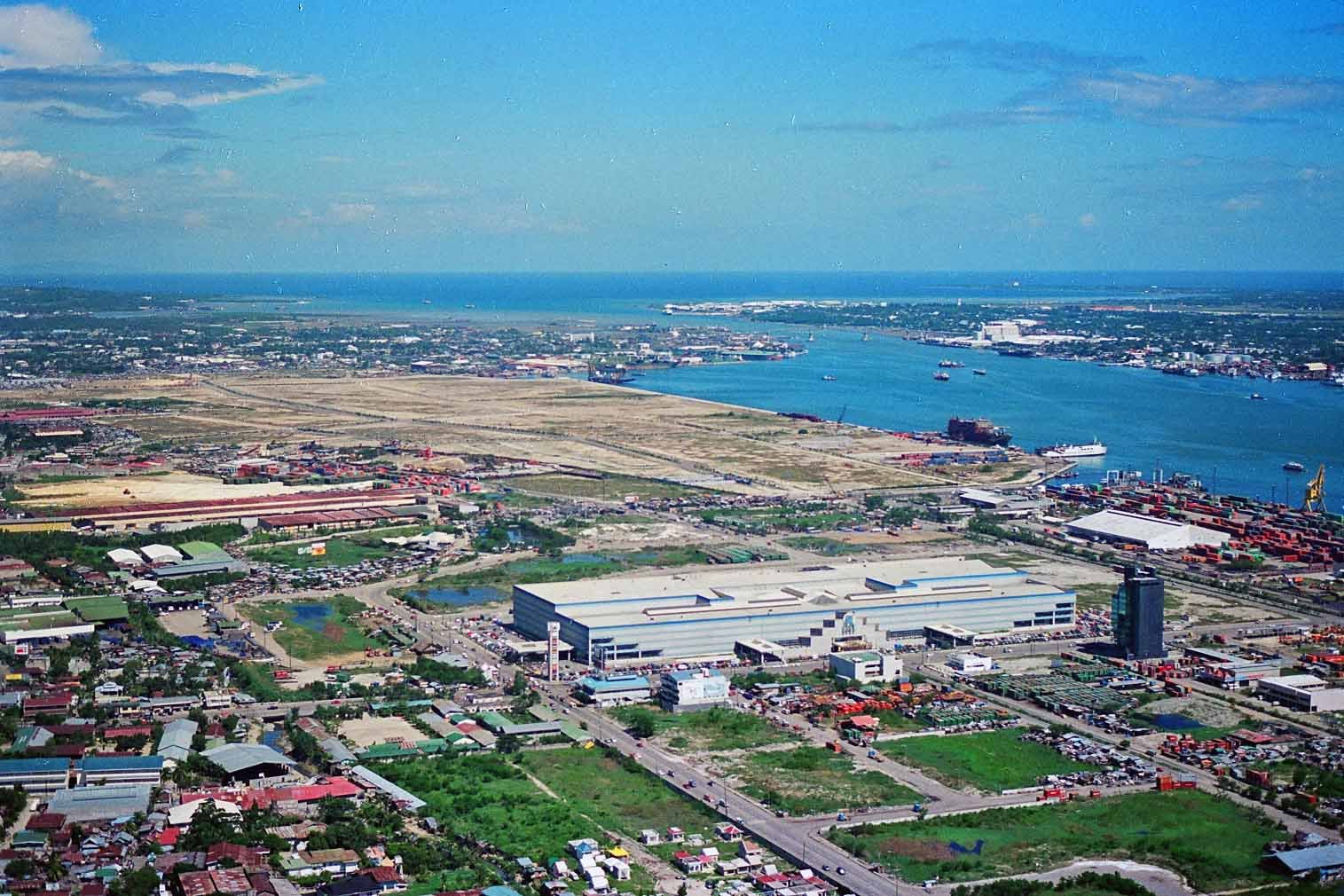
A 500 Million Miracle

“We have been telling the people that this is built by Duros Development Corp. completely on their own.

(A repost from a Sunstar 2015 story)

FOR its 25th anniversary, a construction company turned over to the Archdiocese of Cebu the main venue of an international religious conference in January 2016.

Lito and Fe Barino of Duros Development Corp.

handed a symbolic key to the International Eucharistic Congress (IEC) Pavilion during a ceremony last night to Cebu Archbishop Jose Palma.

The archbishop said that Duros built the facility for more than P500 million and that it can accommodate about 12,000 people.

“We have been telling the people that this is built by Duros Development Corp. completely on their own. So, from the perspective of IEC, this is totally free,” Palma said.

Because the building is free, he said, the proceeds of a fundraising campaign can be devoted to other expenses like the speakers’ transportation, the liturgy, the congress proper and the seminary.

“If not for Duros, we would not be able to cope with the entire Eucharistic Congress,” Archbishop Palma said.

Huge, beautiful

During the Holy Mass, Archbishop Emeritus Ricardo Cardinal Vidal said he believes that the IEC Pavilion is “a miracle from God.”

“I could hardly believe that this would happen, that we have a pavilion as huge as this, as beautiful as this. God has given this and made this a reality. Lord, thank you for giving us this building,” Cardinal Vidal said. “I hope that it will remain forever.”

Archbishop Palma said he believes it would be easy to get bookings for the venue after the IEC in January, Cebu being an attractive destination for events.

“In fact, yesterday, there were a lot of reservations for big events like the Cursillo, and from groups like Couples for Christ and the CBCP (Catholic Bishops Conference of the Philippines), among others. We have bookings already for this year and next year, and we are happy to note that,” Palma said.

Future uses

To help Duros recover the cost of building the pavilion, it will be given the right to develop a two-hectare property near the San Carlos Seminary in Barangay Mabolo, Cebu City.

“Of course, that will be subject to a MOA (memorandum of agreement). Like many others, for instance, they can develop properties of the church that are available for lease until they are able to recover their investments for this pavilion,” Palma said.

In a separate interview, Fe Barino confirmed that they spent more than P500 million for the construction of the structure.

After the IEC, the pavilion will be divided into two: a conference facility and a seminary. Its floor area is 25,754 square meters.

The pavilion can accommodate from 12,000 to 15,000 for the IEC proper. But after it is split once the IEC is over, the remaining conference space can still accommodate 8,000 to 10,000 people.

“The church or the IEC did not spend anything for this pavilion. The fundraising was for the IEC expenses,” Barino explained.

Privilege

This means proceeds from the “Piso Para sa Misa ng Mundo” are solely for the IEC operations expenses.

Barino added that the building was 97 percent done, with finishing touches to be added soon, “but the church can already use the pavilion for any event.”

When asked why Duros agreed to build the pavilion for free, Barino said there was a call from the archbishop “and we just said yes because we feel that it’s also a privilege for us to serve the Lord.”

“We have received so many graces from God. We cannot say no. We want to help Cebu and the Philippines in hosting IEC,” Barino said.

She said that the archbishop’s call was also well-timed, because the company had just finished building Padgett Place condominiums in Lahug, Cebu City.

The condominium was completed in October 2014, and the archbishop called them the month after that.

“Normally, it would take one or two years before we can start a project but here, we were able to mobilize in less than two months,” Barino said.